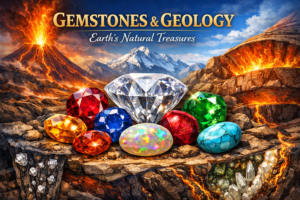
Gemstones have always held a special place in human history. From ancient kings decorating their crowns to modern people wearing gemstone rings for love and luck, these shining minerals are admired everywhere. But what makes gemstones truly fascinating is not only their beauty, but the story hidden inside them. Every gemstone is a product of Earth’s geological processes, shaped by heat, pressure, fluids, volcanoes, and time. In simple words, gemstones are like nature’s artwork, formed slowly beneath our feet over millions of years.
The geology of gemstones is a perfect blend of chemistry and Earth dynamics. Some gemstones are born deep in the mantle under crushing pressure, while others form quietly near the surface in sedimentary environments. Some are created by volcanic eruptions, while others develop due to tectonic collisions and metamorphism. Understanding gemstones from a geological point of view helps us appreciate them not just as ornaments, but as rare natural records of Earth’s evolution.
Diamond
Diamonds are considered the most famous gemstone in the world, mainly because of their brilliance and unmatched hardness. But the real wonder of diamond is its origin. Diamonds form deep inside the Earth, around 150 to 200 kilometers below the surface, in the mantle. At such depths, temperature can exceed 1000°C, and pressure becomes extremely high. Under these conditions, carbon atoms arrange themselves in a very strong crystal structure, producing diamond.
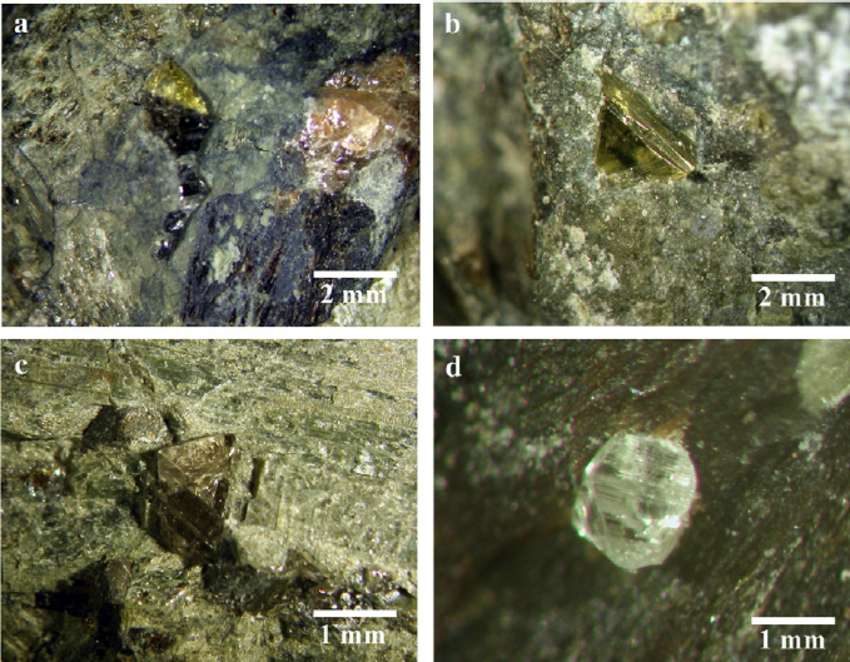
However, diamonds do not naturally come to the surface by normal geological uplift. They reach the Earth’s crust only when powerful volcanic eruptions bring them upward through deep volcanic pipes known as kimberlite and lamproite. These eruptions are rapid and violent, and they transport mantle materials directly to the surface. That is why diamond deposits are often associated with kimberlite pipes, which are important exploration targets for geologists. Diamonds are found in countries like South Africa, Botswana, Russia, Canada, and historically in India, especially in the Golconda region. When you look at a diamond, you are actually holding a piece of the deep mantle, carried upward by volcanic force.
Ruby and Sapphire
Rubies and sapphires belong to the same mineral family called corundum, which is made of aluminum oxide. The difference between ruby and sapphire is mainly the presence of trace elements. Ruby gets its deep red color due to chromium, while sapphire is commonly blue because of iron and titanium. This small chemical variation creates completely different gemstone identities.
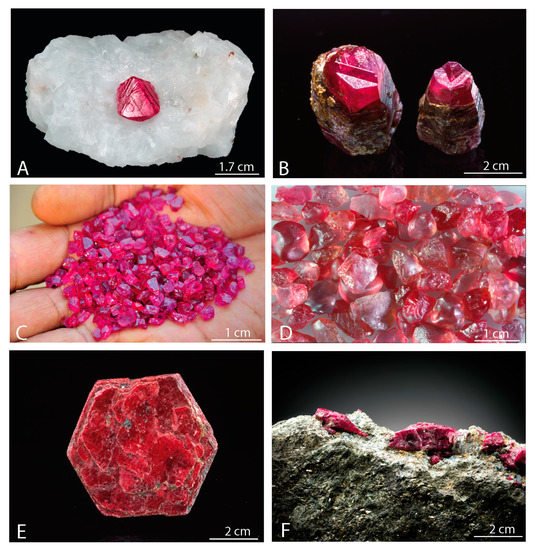
Geologically, corundum forms in high-temperature environments. It is commonly associated with metamorphic rocks like gneiss and marble, especially in regions where intense metamorphism occurs due to tectonic collision. When sedimentary rocks are buried deep and subjected to high pressure and temperature, their minerals recrystallize and form new mineral assemblages. Corundum crystals grow in these conditions, and over time they become large enough to be used as gemstones.
Rubies are often linked with metamorphosed limestone and marble deposits, while sapphires are found in metamorphic belts and also in some igneous rocks. Famous ruby sources include Myanmar, Mozambique, Sri Lanka, and India. Sapphires are found in Kashmir, Sri Lanka, Madagascar, and Australia. Kashmir sapphires are especially valued because they formed under unique Himalayan metamorphic conditions, producing their rare velvety blue color.
Emerald
Emerald is one of the most beautiful gemstones, known for its rich green color. It is a variety of beryl, a mineral made of beryllium aluminum silicate. Emerald formation is geologically rare because it requires beryllium, which is already a scarce element in the crust, and also chromium or vanadium, which provides the green color. The interesting part is that beryllium and chromium are usually found in different types of rocks. So, for emerald to form, nature must bring these elements together under special conditions.
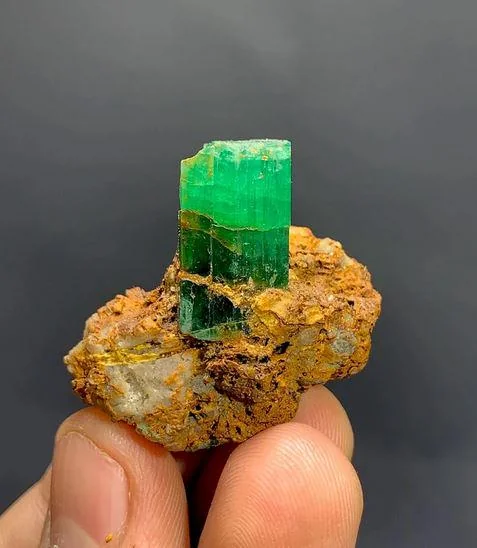
Emeralds typically form in hydrothermal environments, where hot mineral-rich fluids move through fractures and rock boundaries. When these fluids interact with chromium-bearing rocks such as schists or ultramafic rocks, emerald crystals can develop in veins or pockets. Many emerald deposits are related to tectonic zones where fluid activity is strong.
Colombia is the most famous emerald producer because its emeralds formed in sedimentary basins influenced by hydrothermal fluids. Other important sources include Zambia, Brazil, Afghanistan, and India, especially Rajasthan. Emerald is truly a gemstone of geological coincidence, created only when rare chemistry meets the right geological setting.
Garnet
Garnet is not a single mineral but a group of silicate minerals that occur in different colors such as red, orange, green, and purple. Garnets are among the most common gemstones formed during metamorphism. They grow when rocks are exposed to high temperature and pressure, especially during mountain-building events.
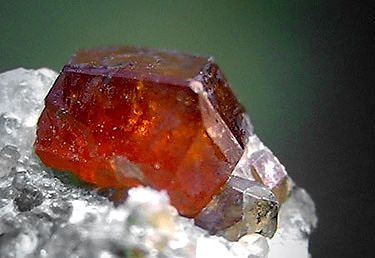
Garnets are commonly found in metamorphic rocks like schist and gneiss. During regional metamorphism, minerals begin to recrystallize and new minerals appear. Garnet forms as a stable mineral under specific pressure-temperature conditions, and because of this, geologists often use garnet as an index mineral to understand metamorphic grade. Garnet crystals often show well-shaped geometric structures, making them attractive not only for jewelry but also for scientific study.
Garnet deposits are common in India, Sri Lanka, Tanzania, Madagascar, and the United States. In many metamorphic terrains, garnets are found embedded in host rocks, looking like natural red crystals locked inside ancient stone.
Opal
Opal is one of the most unique gemstones because it is not crystalline like diamond or ruby. Instead, opal is made of hydrated silica, meaning it contains water in its structure. This gemstone is famous for its “play of color,” where it reflects multiple colors like a rainbow depending on the angle of light.
Opal forms in sedimentary environments, often at shallow depths. The formation begins when silica-rich water percolates through rocks. Over time, silica gets deposited in cavities, fractures, or voids. This slow deposition eventually forms opal. The play of color is caused by the arrangement of microscopic silica spheres, which diffract light and create colorful flashes.
Australia is the largest producer of opal, especially white and black opals. Ethiopia and Mexico are also important sources. Opal is a gemstone that proves that not all precious minerals require extreme heat or pressure. Sometimes, even groundwater can create a treasure if given enough time.
Topaz
Topaz is a silicate mineral containing aluminum and fluorine. It is valued for its clarity and can occur in colors like yellow, blue, pink, and brown. Many people assume topaz is rare, but geologically it is found in several environments.
Topaz commonly forms in igneous rocks such as granite and rhyolite, especially in the late stages of magma crystallization. It is also found in pegmatites, where large crystals grow due to slow cooling and the presence of volatile elements like fluorine. Hydrothermal fluids can also contribute to topaz formation by depositing minerals in fractures and cavities.
Brazil is the most important source of topaz, especially the famous imperial topaz. It is also found in Russia, Pakistan, Nigeria, and parts of India. Topaz is a good example of how magma and mineral-rich fluids work together to form gemstones.
Turquoise
Turquoise is a gemstone known for its sky-blue and greenish shades. Unlike many other gemstones formed deep underground, turquoise forms near the surface. It is a hydrated phosphate mineral containing copper and aluminum.
Turquoise forms in arid climates where copper-rich rocks undergo weathering. Groundwater dissolves minerals and redeposits them in cracks and cavities, producing turquoise nodules. This is why turquoise is often linked with desert regions and oxidation zones of copper deposits.
Major turquoise deposits are found in Iran, Egypt, the southwestern United States, China, and Tibet. Turquoise is a gemstone shaped by surface processes, proving that even weathering and groundwater chemistry can create stunning minerals.
Frequently Asked Questions (FAQ)
1. Which gemstone is the hardest in nature?
Diamond is the hardest natural gemstone, ranking 10 on the Mohs hardness scale. It forms deep inside the mantle under very high pressure and temperature.
2. Why are rubies and sapphires considered the same mineral?
Because both ruby and sapphire belong to the mineral corundum (Al₂O₃). Ruby is red due to chromium, while sapphire shows blue or other colors due to iron, titanium, and other trace elements.
3. How do gemstones form inside rocks?
Gemstones form through geological processes like igneous crystallization, metamorphism, and hydrothermal fluid deposition. Some also form due to weathering and sedimentary deposition, like opal and turquoise.
4. Why are emeralds rarer than many gemstones?
Emerald formation requires rare beryllium-rich fluids interacting with chromium or vanadium-rich rocks. This rare chemical combination makes emerald deposits uncommon.
5. Which gemstones are formed by volcanic activity?
Diamonds are brought to the surface by volcanic eruptions through kimberlite pipes. Some sapphires are also associated with basaltic volcanic rocks.
6. Which gemstones are commonly formed in metamorphic rocks?
Rubies, sapphires, garnets, and sometimes emeralds are commonly formed in metamorphic rocks such as schist, gneiss, and marble.
7. How is opal different from other gemstones?
Opal is not crystalline. It is made of hydrated silica and often forms in sedimentary environments through groundwater deposition. Its rainbow-like color effect comes from light diffraction in silica spheres.
8. What type of rock hosts most gemstones?
Gemstones can occur in igneous, metamorphic, and sedimentary rocks. However, many high-quality gemstones are commonly linked with metamorphic belts and igneous pegmatites.
9. Can gemstones indicate geological processes?
Yes. Many gemstones act as geological indicators. For example, garnet indicates metamorphic conditions, while diamond indicates deep mantle origin.
10. Why do gemstones show different colors?
Gemstone colors are mainly controlled by trace elements, crystal structure, and impurities. For example, chromium makes ruby red, while copper gives turquoise its blue-green shade.