Quartz is one of the most common and important minerals found in the Earth’s crust. It occurs in a wide variety of rocks including igneous, metamorphic, and sedimentary rocks. For geologists and geology students, learning how to identify quartz under a microscope is an essential skill in optical mineralogy and petrography.
When a rock thin section is placed under a petrographic microscope, quartz shows several distinctive optical properties that make it relatively easy to recognize once you understand what to look for. In this article, we will explore step-by-step methods to identify quartz under a microscope, including its appearance in plane polarized light (PPL) and cross polarized light (XPL).
What is Quartz?
Quartz is a silicate mineral composed of silicon dioxide (SiO₂). It is one of the most abundant minerals on Earth and is commonly found in rocks such as:
- Granite
- Sandstone
- Quartzite
- Gneiss
- Schist
Because quartz is chemically stable and resistant to weathering, it often survives geological processes and remains present in many rock types.
Under the petrographic microscope, quartz has several unique optical properties that help distinguish it from other minerals like feldspar or calcite.
Why to Identify Quartz in Thin Sections?
Identifying quartz is important for many geological interpretations. When geologists examine thin sections under a microscope, quartz helps them understand:
- Rock composition
- Rock origin and formation
- Metamorphic grade
- Sedimentary transport history
For example, a sandstone composed mostly of quartz grains indicates a mature sedimentary rock, while quartz in granite reflects igneous crystallization.
Observing Quartz in Plane Polarized Light (PPL)
The first step in identifying quartz is to observe the thin section under plane polarized light (PPL). In this mode, only the polarizer is inserted and the analyzer is removed.
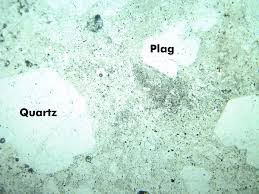
Quartz shows several diagnostic features in PPL.
Color of Quartz
Quartz is colorless in plane polarized light.
Unlike minerals such as biotite or hornblende, quartz does not display strong colors. This absence of color is one of the first clues when identifying quartz.
If you see a grain that is completely transparent and colorless, it may be quartz or another colorless mineral such as feldspar.
Relief of Quartz
Relief refers to how much a mineral grain stands out compared to surrounding minerals.
Quartz shows low relief, meaning its boundaries appear smooth and not very prominent.
When focusing the microscope, quartz grains usually blend gently with the surrounding minerals rather than appearing strongly outlined.
Cleavage
One important property of quartz is that it does not show cleavage.
Many minerals such as feldspar or mica display clear cleavage planes, but quartz grains typically lack such planes. Instead, they may show irregular fractures.
This absence of cleavage is another useful feature for identifying quartz.
Crystal Shape
Quartz grains in rocks often appear as irregular or anhedral grains.
In igneous rocks like granite, quartz commonly fills the spaces between other minerals and forms interstitial grains. In sedimentary rocks such as sandstone, quartz grains may appear rounded or subrounded due to weathering and transport.
Observing Quartz in Cross Polarized Light (XPL)
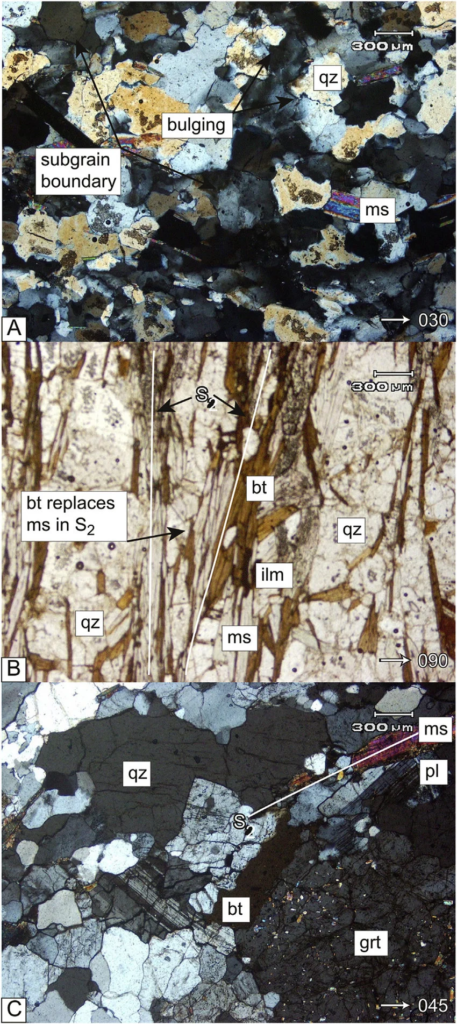
After observing the mineral in PPL, the next step is to insert the analyzer to observe the thin section under cross polarized light (XPL).
This mode reveals additional optical properties that help confirm the presence of quartz.
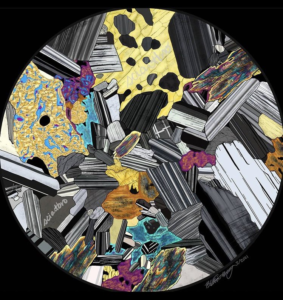
Interference Colors
Quartz typically shows low-order interference colors under cross polarized light.
These colors are usually:
- Grey
- White
- Pale yellow
Quartz rarely shows bright colors like calcite or mica. The presence of low-order grey to white interference colors is one of the most important diagnostic features.
Undulose Extinction
One of the most characteristic features of quartz is undulose extinction.
When the stage of the microscope is rotated, quartz does not become dark all at once. Instead, different parts of the grain go dark at slightly different times.
This wavy pattern of extinction is known as undulose extinction and is very common in quartz, especially in metamorphic rocks.
Undulose extinction often indicates that the quartz grain has experienced tectonic stress or deformation.
Absence of Twinning
Another important feature is that quartz does not show twinning under normal conditions.
Many feldspar minerals display clear twinning patterns, such as albite twinning or cross-hatched twinning. Quartz lacks these patterns.
If a colorless grain shows twinning under XPL, it is most likely feldspar rather than quartz.
Step-by-Step Method to Identify Quartz
When analyzing a thin section, geologists typically follow a systematic approach.
Step 1: Observe the Mineral in Plane Polarized Light
Check whether the grain is colorless and transparent.
Step 2: Look for Cleavage
If the grain shows no cleavage and only irregular fractures, it may be quartz.
Step 3: Check the Relief
Quartz should show low relief compared to surrounding minerals.
Step 4: Switch to Cross Polarized Light
Insert the analyzer and observe interference colors.
Step 5: Observe Interference Colors
Look for low-order grey or white colors.
Step 6: Rotate the Stage
Watch for undulose extinction as the stage rotates.
Step 7: Check for Twinning
If twinning is absent, the mineral is likely quartz.
By following these steps, quartz can be confidently identified in most rock thin sections.
Quartz in Different Rock Types
Quartz appears differently depending on the rock type being studied.
Quartz in Igneous Rocks
In igneous rocks like granite, quartz forms interlocking grains with feldspar and mica. The grains are often irregular and fill spaces between other minerals.
Quartz in Sedimentary Rocks
In sandstone, quartz grains are usually rounded or subrounded due to transport by water or wind.
These grains may also show overgrowths of quartz cement, which bind the sediment together.
Quartz in Metamorphic Rocks
In metamorphic rocks such as quartzite and schist, quartz grains may display undulose extinction and recrystallized textures.
These textures provide evidence of deformation and metamorphism.
Common Mistakes When Identifying Quartz
Beginners sometimes confuse quartz with other colorless minerals.
Some common mistakes include:
Confusing Quartz with Feldspar
Feldspar shows twinning, while quartz does not.
Confusing Quartz with Calcite
Calcite shows very bright interference colors, unlike quartz.
Ignoring Undulose Extinction
Undulose extinction is a strong indicator of quartz, especially in metamorphic rocks.
Careful observation of multiple optical properties helps avoid these mistakes.